 When did massage become about how much pain you can tolerate?
Let’s talk about something I feel quite strongly about.
There seems to be a growing trend in massage and bodywork where treatments are judged by how much pressure is applied, how painful they are and, in some cases, how dramatic the marks left behind look.
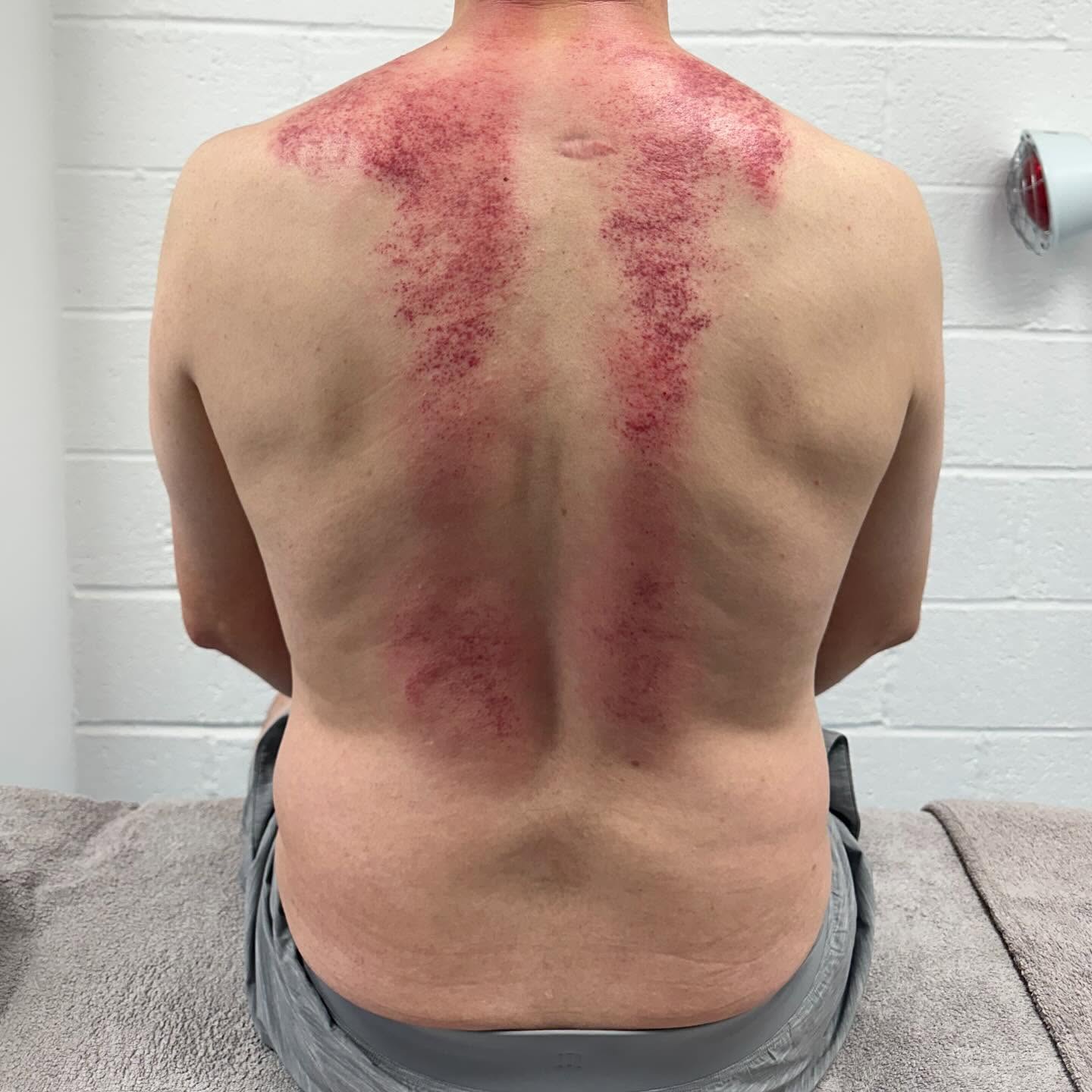
You’ve probably seen photographs like the one accompanying this article: large areas of red, purple and bruised-looking skin following treatment with scraping tools.
And I want to ask a simple question:
What exactly are we trying to achieve here?
As a massage therapist, I believe our job is to help people feel better, move more comfortably and support their bodies through skilled, considered and appropriate hands-on treatment.
It is not to cause unnecessary trauma to the tissues in the belief that the more damage we create, the better the result.
Some practitioners use instruments to scrape or apply repeated friction to the skin and underlying tissues. These techniques are often referred to as instrument-assisted soft tissue mobilisation (IASTM) or are associated with practices such as Gua Sha.
There are different approaches, and not every practitioner uses these tools in the same way.
However, some methods deliberately aim to produce petechiae – tiny red or purple spots caused by bleeding from small blood vessels close to the skin’s surface. More significant bruising can also occur.
These marks are not evidence that adhesions have been broken down, that fascia has been released or that toxins have been removed.
They are signs of a physical response to the treatment, and potentially tissue trauma.
There is also an important distinction between a temporary change in skin colour and deliberately creating bruising or capillary damage as a treatment goal.
Bruising is not proof of a successful treatment. Pain is not proof that something is working. And leaving someone marked is not a measure of your skill as a therapist.
This is where I think we need to look beyond marketing claims and consider the evidence.
Research into instrument-assisted soft tissue techniques is mixed. Some studies suggest potential benefits for certain outcomes, but the quality of evidence varies considerably.
An updated systematic review published in 2022 examined 46 randomised controlled trials and concluded that the evidence was too weak to support clinically meaningful improvements in pain, function or range of movement.
Other, more recent research has reported possible benefits in particular circumstances. However, this does not demonstrate that causing bruising or deliberately damaging tissue is necessary to achieve those benefits.
In other words, there is no good reason to assume that the more dramatic the marks, the more effective the treatment.
I believe we should be questioning any approach that places unnecessary emphasis on how much force can be applied, rather than what is appropriate for the individual receiving treatment.
One of the biggest misconceptions I come across is that a massage needs to be painful to be effective.
It really doesn’t.
Effective treatment requires an understanding of anatomy, physiology, the nervous system and how the body responds to touch and pressure.
It means knowing when to apply pressure, when to ease off, which techniques are appropriate and, just as importantly, when not to treat an area.
It also means understanding that every person is different.
Someone experiencing chronic pain, heightened sensitivity, stress or a history of trauma may respond very differently to treatment than someone else.
Good bodywork isn’t about forcing the body to change. It’s about working with it.
At Bodywise, I use a combination of hands-on myofascial techniques, targeted stretching and other appropriate treatment approaches, adapting each session to the individual.
My aim is always to work thoughtfully and purposefully, respecting the tissues rather than trying to overpower them.
This is something I feel particularly strongly about.
In the UK, the title ‘massage therapist’ is not legally regulated. This means there is no single statutory licensing requirement that everyone must meet before practising under that title.
That makes it especially important to do a little research before booking a treatment.
Here are a few things I’d encourage you to check:
1. What qualifications do they hold?
Ask about their training and qualifications. Have they completed recognised training in massage therapy? Do they understand anatomy, physiology, contraindications and safe treatment practices?
2. Are they a member of a recognised professional association?
Professional organisations have their own membership requirements and standards. Some practitioners are also registered with the Complementary and Natural Healthcare Council (CNHC), which has a Professional Standards Authority-accredited register.
3. Do they have appropriate insurance?
A properly insured practitioner should be able to confirm that their insurance covers the treatments and techniques they offer.
4. Do they explain what they’re doing and obtain your consent?
You should never feel pressured into a technique, particularly one involving significant discomfort. A good therapist will explain the treatment, discuss your preferences and listen if something doesn’t feel right.
5. Do they adapt their treatment to you?
Your body isn’t the same as everyone else’s. Treatment should be tailored to your needs, health history, comfort and response.
Please don’t be afraid to ask questions. A good practitioner should welcome them.
I don’t believe in using excessive force to demonstrate how deep or effective a treatment is.
I don’t believe that bruising should be worn as a badge of honour.
And I certainly don’t believe that clients should feel they have to endure pain or discomfort to get results.
I believe in understanding the body, continually developing my knowledge, using appropriate techniques and treating every client as an individual.
Sometimes the most effective treatment isn’t the deepest or most intense. It’s the one that is right for your body on that particular day.
Your body deserves skill, knowledge, respect and care – not unnecessary trauma.
If you’re looking for a massage therapist who takes a considered, individual approach to your treatment, I’d love to welcome you to Bodywise.
Caroline x
Bodywise Massage